Source: PigBusiness
Text: Reinout Burgers
There is a good chance that free-range farrowing pens will become the norm, but there is still little experience with them. This is why WUR and VKON at a pig farmer’s Jarno Brummelhuis to organise a roadshow. One striking aspect is that Topigs manages to achieve a low mortality rate at its research farm in Canada without confining the sows.
Few sow farmers have free-range farrowing pens. This is partly because investment is low due to the complexity of the planning permission process, but also because there is as yet no binding legislation requiring such a farrowing pen system. That may change in the future, now that the EFSA (European Food Safety Authority) embraces the move away from tethering animals. In any case, the fact that there are few free-range farrowing pens is certainly not due to a lack of interest on the part of pig farmers.
At the roadshow hosted by Jarno Brummelhuis in Hoge Hexel (OV), the attendees were exclusively pig farmers, only a few of whom had experience with free-range farrowing pens. Due to the high level of interest, VKON is organising a second roadshow on free-range farrowing pens. The roadshows form part of the ‘Kennis op Maat’ project entitled ‘Roadshow: The Benefits of a Well-Designed Activity Area for Pigs’ and are led by WUR and VKON.
WUR researcher Marko Ruis is closely involved in the roadshows and has noticed that there is a great deal of international interest in free-range farrowing pens. “This could well become law, and it’s good that pig farmers are already working on this. What Jarno has here is certainly a very good concept.”
Simple in design
Topigs Norsvin Sub-breeder Jarno Brummelhuis has now had more than ten years’ experience with free-range farrowing pens. On his farm, he has 530 breeding sows, which he uses to breed TN50 and TN70 replacement gilts. He uses the weekly system and has been weaning at five weeks of age for the past year. The pregnant sows are moved into the free-range farrowing pens just before their expected farrowing date and are moved out again after five weeks (at weaning), whilst the weaned piglets remain in the pen. So, for the piglets, little changes. “We have tested the free-range farrowing pen extensively and it is simple in design. It was devised by the farmer and designed with the animal’s welfare in mind,” Brummelhuis tells the pig farmers.
“For me, the success of free-range farrowing pens lies in their simplicity: the clear overview during inspections, ease of work, feeding by allowing piglets and sows to eat together, no weaning dip, less wash water, lower heating costs and, of course, the animals’ welfare. Piglets and sows are now better able to express their natural behaviour. However, this does require a calm sow with good, strong legs, giving her the strength to lie down gently rather than plonking herself down, and, of course, robust, lively piglets.”
Testing the freewheel
The first free-range farrowing pens that Brummelhuis tested on his own farm were the Pro Dromi farrowing pens, but as the nannies did not fit into the farrowing and rearing concept, the pig farmer developed his own free-range farrowing pen. In the test barn, which housed six farrowing-rearing pens, he spent two years from 2014 testing various configurations. During those two years of testing, Brummelhuis improved the free-range farrowing pen in collaboration with Nijenkamp, amongst others, and the result is a system that works well in practice and has been stripped of all unnecessary elements. December 2016 saw the opening of the new free-range farrowing and rearing unit, comprising 11 sections with 22 pens per section.
Brummelhuis: ‘On Wednesday we hose down the farrowing pens, and on Thursday we move 22 sows in. We set up a new line and move the sows into a pen holding 22 sows. This is done very calmly, with all 22 sows at the same time. The gates are easy to operate. On Monday, we temporarily secure the sows and the pen temperature is then 22 degrees Celsius. The piglets are born over the course of the week. On Thursday, once the last piglets have been born, we lower the temperature to 19 degrees Celsius. Five to seven days after the birth, the sow is released again. Until then, the piglets are safe in the piglet nest. The piglets and the sow like to be together, which is why the piglet nest is placed at the sow’s head end.”
The innovative sub-breeder had initially let the sows out after just three days, but when it turned out that this actually led to a slightly higher mortality rate, he now keeps them confined for a little longer.
“Our mortality rate is similar to that in the past and in other farrowing pens.”
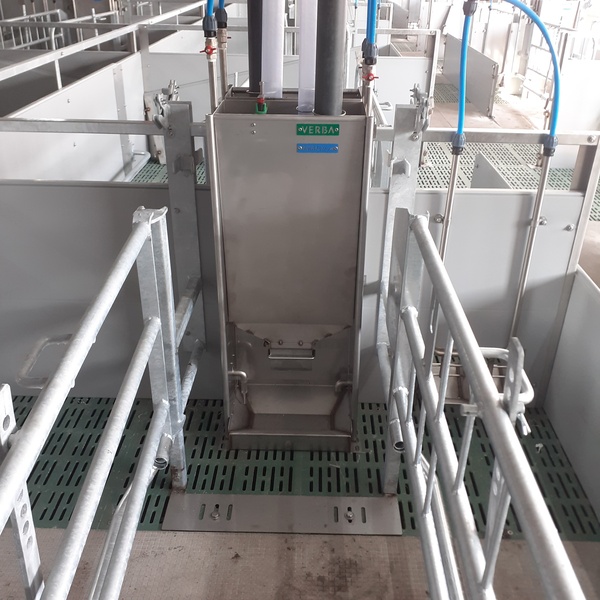
An important aspect of free-range farrowing pens is the interaction between sow and piglet, which allows them to display more natural behaviour, such as learning to eat. “You can see this when the sow is feeding; the piglets want to eat too,” explains the sub-breeder. “They start doing this after just three days. We have therefore deliberately opted for the low VERBA KZB family feeders chosen. Research into feed residues in the slurry pit shows that feed wastage is minimal.”
In a high-sided trough, there is more spillage, because the sow wants to feed the piglets out of natural instinct and pushes the feed over the edge of the trough.
Feeding behaviour in free-range farrowing pens
Brummelhuis is not the only speaker at the Roadshow. Anouschka Middelkoop, a researcher in Swine Nutrition at Schothorst Feed Research (SFR), explains the free-range farrowing pens at SFR and then discusses ‘eating together, learning together’ in relation to the feeding behaviour of piglets in free-range farrowing pens. At SFR, the sow remains confined for approximately four days after farrowing, with a balance floor installed beneath her. This rises when the sow stands up.
“Following the switch to free-range farrowing pens with slatted floors, we saw a reduction in the percentage of piglets that died in the pen, from 6 to 4.3 per cent, and we were able to reduce mortality in the farrowing unit. We wean the piglets alternately at 30 days, after which they move to the weaning pen. Unlike Brummelhuis, we use high feed troughs. This is because, as a research farm, we want to monitor and measure what the piglets and sows eat. However, free-range farrowing pens offer many additional opportunities for piglets to learn to eat from the sow. There are also more ways to offer different types of feed.”
Middelkoop continues her story: “In the wild, we see that piglets start foraging and exploring on day 5. By day 10, piglets and sows are already eating together, and the piglets learn from the sow what, where and how to eat. You can apply this in the farrowing pen using a family feeding system, for example by feeding the sow from a low feed trough.” According to Middelkoop, using a family feeding system instead of a high feed trough gives the piglet more opportunities to see what and how the sow eats. “A piglet is more likely to start eating when the other pigs are at the feed trough. Moreover, the piglet wants to eat the same food as the others. In studies using a family feeding system, 73 per cent of piglets learn to feed before weaning, and they learn this particularly at a younger age. This can lead to higher feed intake and growth.”
Improved digestion and efficiency
By starting to offer solid feed to suckling piglets at an early stage, they not only have time to learn to feed from the sow, but their intestines also have time to develop properly and adapt to this nutritional change. It is therefore important to continue feeding the same piglet feed around the time of weaning, as the piglet and its gut flora are accustomed to it. Middelkoop: “The fact that piglets also eat sow feed is not a problem at all. It is actually an advantage, because eating sow feed makes the intestinal villi longer, thereby increasing the intestinal surface area. The larger intestinal surface area leads to better digestion and greater efficiency.”
Furthermore, Middelkoop’s PhD research has shown that offering several types of feed can increase piglet feed intake. By allowing piglets to feed on the lactation feed alongside their sow, in addition to providing piglet feed in their own trough, total solid feed intake will be higher. This ensures a good start after weaning, and sometimes even a higher weaning weight. To encourage piglets to eat, it is also important that the feed is provided fresh; large pellets can help piglets develop the motor skills needed to eat them, and it can be helpful to offer the feed moistened at first.
Brummelhuis largely follows the same principles as Middelkoop. For example, the VERBA family feeder (KZB) is accessible to the piglets as it stands on the floor, and after just 5 days the piglets are given a small trough containing the same piglet feed that they are given after weaning. In the pig farmer’s experience, the piglets first pick out the larger pieces from the feeder. As the piglets and sows keep the VERBA family feeder clean themselves, the piglets always have access to fresh feed.
Maternal traits
Genetics and free-range farrowing pens go hand in hand, because it is precisely because the sow is free to roam that she must be calm and possess good maternal traits. Breeding organisations can select for these traits. At its new innovation centre, Innova, in Canada, Topigs Norsvin is conducting research into free-range farrowing pens. Why? The breeding organisation is convinced that the free-range farrowing pen is the future and will be enshrined in legislation. “We always breed with the future in mind,” explains Lisette van der Zande, a researcher at Topigs Norsvin. “Because breeding takes time. That also means keeping an eye on how legislation is set to develop in the area of animal welfare and responding to this with our genetics. So we’re also investigating the use of free-range farrowing pens, and in Canada we have the Prodromi. I’m studying the behaviour of piglets and sows in the free-range farrowing pens and the risk of higher mortality. Sometimes we let the sows out after a day, or we don’t pen them in at all. The interaction between piglet and sow is important here. Why might there be higher mortality? This could be due to a clumsy sow, but it could also be related to the piglets’ vitality. “We can select for breeding values for maternal traits.” In Canada, cameras are installed to monitor behaviour, and the Topigs Norsvin researcher can view the footage at any time from the Netherlands. The research aims to select for genetic traits and incorporate the data into breeding programmes. What Van der Zande observes in the free-range farrowing pens is that the higher the breeding value for maternal traits, the lower the piglet mortality. “We see this effect particularly in the free-range farrowing pens and not in the standard pens. The mortality rate in the free-range farrowing pens is now at the same level as that in the standard pens. Using the cameras, we record the interaction between piglet and sow – how often, where and what. This allows us to focus more specifically on behaviour with the aim of reducing mortality. We have, however, been selecting for maternal traits for years, but this is particularly important in a free-range farrowing unit.”
Those who lie on their stomachs are dead
Nevertheless, the research is already showing other encouraging results. ‘We can see that the sow’s posture predicts whether there will be a high or low culling rate. Sows with one or more stillborn piglets appear to lie on their stomachs more often. Why? Perhaps it has something to do with their legs or udder. After all, if they have mastitis, they often lie on their stomachs too. We were able to observe this even before farrowing, and it could be used as a management tool. It is also mainly the small piglets that die.”
It is striking that Brummelhuis has had more or less the same experience. Sows that had a high mortality rate in a conventional farrowing pen were also found to have a higher mortality rate in the free-range system, and vice versa. Perhaps genetics does, after all, have a significant influence on mortality rather than the farrowing pen system alone. For Brummelhuis, the free-range farrowing pen is definitely the ideal farrowing pen. “At least for us. The key figures are the same as in the old system and it’s a much more relaxed way of working. Mortality will always be a point of concern, which is why we select our sows on this basis as well.”